
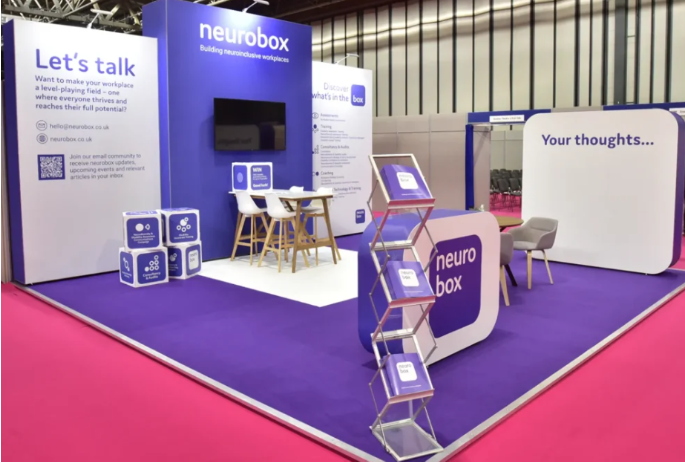
There is a particular kind of invisibility that happens at exhibitions. A brand can have a genuinely excellent product, a well-trained team, and a prime location on the floor — and still be walked past repeatedly. The issue is rarely the product. It is the failure to stop someone mid-stride with something visually compelling enough to interrupt their path. Most exhibitors underestimate how much physical presentation drives that first moment of curiosity. Exhibition display stands are doing far more behavioural work than most businesses give them credit for.
The Psychology of Stopping
Visitors at exhibitions are not browsing — they are scanning. Their eyes move quickly across a hall looking for visual anchors, something that breaks the monotony of repetitive layouts. What causes someone to slow down is rarely a clever tagline at that distance. It is contrast, structure, and spatial confidence. A stand that uses height, clear negative space, and a dominant focal point creates a subconscious signal that something organised and intentional is happening here. That signal triggers curiosity before the conscious mind has decided to be interested. Most exhibitors are competing on messaging when the real competition is happening at a purely visual level first.
Portability Is a Strategic Asset
The logistical reality of exhibiting regularly is exhausting. Businesses that treat display infrastructure as heavy, complicated, or event-specific tend to exhibit less frequently and less confidently. Modern portable display systems change that calculation entirely. When a stand travels easily, sets up quickly, and arrives without damage, the team showing up at the event is focused and composed rather than frazzled from a difficult setup. That energy is visible to visitors. A team that arrived calmly presents differently from one that spent the morning wrestling with poles and panels. Portability quietly shapes the human performance behind the display.
Consistency Builds Recognition
There is a compounding effect to exhibiting with visual consistency that most brands never stay in one place long enough to experience. When the same colour palette, spatial layout, and structural language appears across multiple events over time, something shifts. Industry visitors begin to place the brand before they consciously remember the name. That ambient recognition is extraordinarily valuable and almost impossible to build through digital channels alone. Exhibition display stands that maintain visual coherence across events are not just looking professional — they are steadily depositing into a recognition account that pays out in credibility long after the event ends.
Small Footprints, Serious Impact
The assumption that a larger stand automatically commands more attention does not hold up under scrutiny. Some of the most effective exhibition presences are compact, precisely because they are considered. A small footprint forces clarity — there is no room for clutter, mixed messaging, or unnecessary elements. That constraint, paradoxically, produces sharper communication. Visitors read a tight, well-designed exhibition display stand faster and remember it longer than a sprawling setup that tries to say everything at once. Constraint is not a limitation; handled well, it is a design advantage that larger budgets often accidentally work against.
Graphics Age, Structures Do Not
One of the quieter financial and strategic mistakes exhibitors make is treating the entire display as disposable — replacing everything when a campaign changes. The more intelligent approach separates structure from surface. A well-built modular frame holds its value across years and multiple rebrands. The graphic panels that slot into it are the part that ages, and those can be updated independently. Businesses that understand this distinction exhibit more frequently, adapt faster to new campaigns, and carry less anxiety about the return on each individual event. The infrastructure becomes a platform rather than a cost.
Conclusion
An exhibition stand is never just a backdrop. It is doing active work — attracting, qualifying, and communicating on behalf of a brand in a crowded, competitive environment. Exhibition display stands that are thoughtfully chosen and consistently maintained give businesses a compounding advantage that grows with every event attended. The brands that treat their physical presence as seriously as their digital one tend to build the kind of credibility that converts. Showing up well, repeatedly, is its own form of marketing — and it works.