Dog owners who train at home and then wonder why everything goes apart in the park are not failing at training. They are successful at the wrong thing. A dog who learns to sit in a quiet kitchen, for the same owner, with the same reward pouch, at the same place every evening, has learnt to sit under one very precise set of circumstances. Change the environment, add a bicycle, introduce another dog, or have a stranger deliver the order, and that same dog may seem entirely untrained. It is not defiance. Stimulus generalisation — the process by which a learnt behaviour spreads across contexts — is something that needs to be purposefully constructed. Group dog training is one of the few venues intended particularly to develop it.
The Owner’s Body Language Problem
People are not aware of how much they communicate physically. An owner who feels tense the moment another dog approaches has already told their dog something is wrong — through a tightened lead, a shifted weight, a held breath — before the other dog is even close. The dog reads those signals as confirmation that the other dog is a threat worth reacting to. In a group setting, this dynamic becomes observable to a skilled trainer in a way it never is at home. Owners who have trained privately for months and still cannot understand why their dog reacts on-lead often discover in their first group session that they have been cueing the reaction themselves, consistently, without realising it.
What Repetition Without Variety Actually Produces
Private training and backyard practice produce repetition. That repetition builds fluency — the dog becomes fast and accurate at the behaviour in that context. What it does not build is flexibility. A dog with high repetition in one context and zero exposure to varied contexts has a brittle skill — reliable under conditions it recognises, unreliable as soon as conditions shift. This is why many privately trained dogs that perform beautifully in videos fail in real life. The training was deep but narrow. Group dog training forces breadth. Different people, different surfaces, different smells, different dogs, different energy levels — each session adds variability that strengthens the behaviour across a wider range of real-world conditions.
Why the Anxious Dog Needs Group More Than Anyone
The instinct for owners of anxious dogs is to protect them from group environments. Keep them away from stimuli. Manage the situation so the dog is never overwhelmed. That instinct is understandable and it is also, in the long term, counterproductive. Avoidance prevents short-term distress but teaches the dog nothing about how to recover from mild discomfort. A well-run group class introduces an anxious dog to manageable levels of arousal repeatedly — not flooding, not forcing, just structured exposure with a trained eye monitoring the dog’s responses. Over time, the dog’s window of tolerance expands. Group dog training run by someone who understands anxiety-based behaviour does not push dogs past their limit. It expands where the limit sits, incrementally and consistently.
The Social Skill Owners Forget to Teach
There is a specific skill that most pet dogs never learn: the ability to be near other dogs without interacting with them. In daily life, this skill matters constantly — on a footpath, in a waiting room, at a cafe. But owners almost never teach it explicitly because they assume dogs either like other dogs or they do not, and that this is fixed. It is not. A dog that has been systematically rewarded for orienting toward its handler in the presence of another dog, over many repetitions across varied distances, has been taught a specific behaviour that replaces the default reactive or over-excited response. That kind of teaching only happens reliably in environments where other dogs are present and the trainer can structure the exposure.
When Progress Looks Like Failure
A dog that behaves worse in the first group session than at home has not gotten worse at training. It has encountered real-world demands for the first time. The gap that opens up in that first session between what the owner expected and what the dog delivered is not a setback — it is a diagnostic. Every behaviour that breaks down in that environment is a behaviour that would have broken down in real life anyway, just without a trainer present to help address it.
Conclusion
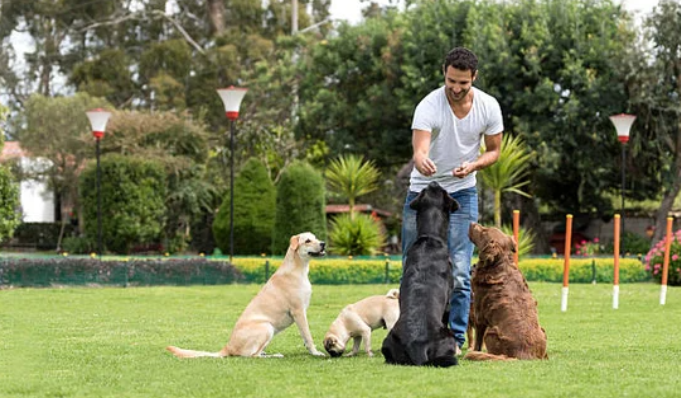
Group dog training works not because it is more rigorous than private training, but because the environment it creates is irreplaceable. The unpredictability, the other dogs, the varied handlers, and the shifting stimuli are not incidental features of a group class. They are the mechanism through which durable, generalised, real-world behaviour is built. No amount of kitchen practice produces what one well-run group session begins to develop.