
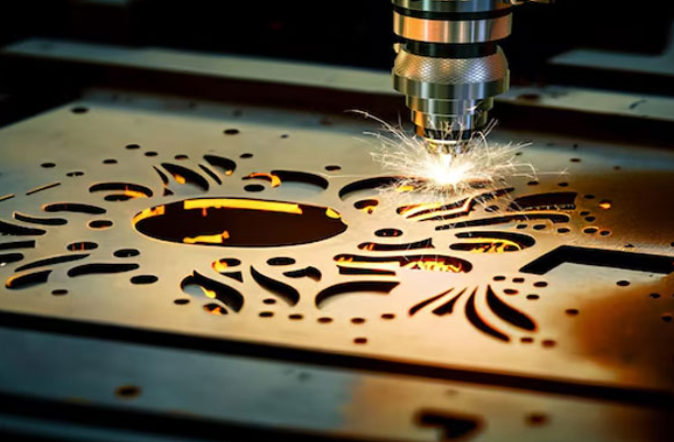
Brass is a material that rewards precision and punishes approximation. Its visual qualities — the warm tone, the way it takes a finish, the distinction it brings to a component or decorative element — are only fully realised when the cutting process that precedes finishing is genuinely accurate. The problem is that brass also presents specific processing challenges that catch out fabricators who treat it like any other non-ferrous metal. Brass laser cutting sits at the intersection of these two realities — a process capable of extraordinary accuracy on a material that requires genuine process knowledge to cut well. Understanding what that combination actually delivers, and why, is worth examining properly.
Reflectivity Is the Real Challenge
Most conversations about laser cutting brass mention reflectivity in passing, as though it were a minor footnote. It is not. Brass returns a substantial portion of laser energy back toward the cutting head, and the consequences of managing that poorly ranged from inconsistent cut quality to equipment damage that is neither minor nor quick to resolve. The reason fibre lasers handle brass significantly better than CO₂ systems is not marketing preference — it is physics. The wavelength produced by a fibre laser is absorbed by non-ferrous metals far more effectively, which means the energy goes into cutting the material rather than reflecting back into the optics. Fabricators who understand this distinction produce consistently clean results. Those who apply the wrong laser type to brass produce unpredictable ones.
What a Clean Edge Actually Changes
The downstream consequences of edge quality are rarely discussed in enough detail to be useful. A burr left by a mechanical cutting process is not just an aesthetic problem — it is a functional one. In assembled components, burrs affect fit and create stress concentration points that matter under load or vibration. In decorative applications, they require hand finishing that introduces inconsistency across a batch. Brass laser cutting produces an edge condition that is fundamentally different — clean, consistent, and in many applications requiring no secondary finishing at all. The time and labour that disappears from the post-processing stage when edge quality is handled at the cutting stage is significant, and it compounds across volume production.
Complexity Is Where Laser Cutting Separates Itself
Mechanical cutting processes carry an invisible design tax. Certain geometries require tool changes, multiple setups, or compromise between what was designed and what can be manufactured reliably. Internal corners get radiused because the tooling demands it. Fine detail gets simplified because it cannot survive the mechanical forces involved. Brass laser cutting removes most of these constraints in a way that changes the design conversation entirely. Geometry that would have required multiple operations collapses into a single cutting pass. Internal detail that mechanical processes would destroy holds cleanly because the cutting action never physically contacts the material. Designers who internalise this freedom tend to produce work that looks qualitatively different from what was achievable before.
Consistency That Mechanical Processes Cannot Sustain
There is a degradation curve built into every mechanical cutting process that tends to get ignored until it becomes a quality problem. Tooling wears, and as it wears, the cut it produces changes — edge condition deteriorates, tolerances drift, and the component produced late in a production run differs from the one produced at the start. Laser cutting does not follow this curve in the same way. Properly maintained and correctly set up, it produces the same result at the end of a run as at the beginning. For applications where component interchangeability is a genuine requirement rather than a theoretical preference, that consistency changes what is actually achievable in practice.
Where the Process Has Honest Limits
Applying laser cutting universally to brass regardless of application produces disappointing results in specific contexts. As material thickness increases beyond the range suited to sheet fabrication and precision components, cut quality degrades noticeably — dross formation increases, edge perpendicularity suffers, and the advantage over alternative processes narrows considerably. The fabricators who use laser cutting most effectively are the ones who understand these limits clearly enough to apply the process where it excels and recommend alternatives where it does not.
Conclusion
Brass laser cutting is not simply a faster version of what mechanical processes already do. It produces outcomes that mechanical cutting genuinely cannot replicate — in edge quality, geometric complexity, and production consistency simultaneously. For fabricators and designers working seriously with brass, understanding the process deeply enough to apply it correctly is what separates work that fully realises the material’s potential from work that merely approximates it. That distinction shows clearly in the finished result.