
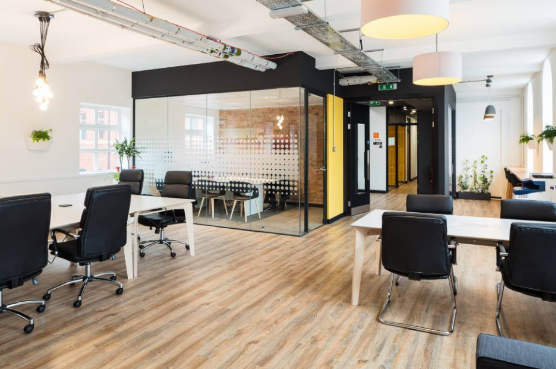
Walk into almost any commercial building and something becomes clear quickly. The space either works with the business, or it quietly works against it. Not always obvious at first glance, but it shows up in movement, in hesitation, in how people use corners, corridors, and shared areas. That is where commercial refurbishment often starts to matter. Not as decoration. Not as surface improvement. More as a correction of how space behaves in reality compared to how it was originally intended.
Hidden Inefficiencies
Most workplaces carry small inefficiencies that no one calls out. They accumulate slowly. A desk moved here, a partition added there, storage pushed into whatever space was left. Individually, nothing feels urgent. But over time, movement becomes less natural. Teams adjust instead of questioning. People take longer routes without thinking about it. Certain areas get avoided entirely. Refurbishment exposes these patterns. Not in theory, but in how people actually move through a building. What looks like a layout issue is often something deeper. A workflow that no longer matches the space it sits in.
Perception Layer
There is always a layer between a business and its visitors. That layer is the environment itself. People rarely analyse it consciously. They react instead. A space feels organised, or it does not. It feels coherent or slightly unsettled. Those reactions form early and tend to linger longer than expected. A tired reception area can distort perception before any conversation begins. Not because anyone is judging harshly, but because environments set expectations quietly. A commercial refurbishment shifts that layer. Not by adding complexity, but by removing distraction. Cleaner spatial logic. Clearer movement. Fewer moments where a visitor pauses without knowing why.
Behaviour Shift
Workplaces shape behaviour in ways that are often overlooked. Not through rules, but through friction. If collaboration spaces are difficult to reach, collaboration happens less. If quiet areas are uncomfortable, focus becomes inconsistent. People adapt to space rather than question it. That adaptation becomes routine. Over time, behaviour inside a building starts to reflect the building itself. Not the intended culture, but the practical reality of the environment. Refurbishment interrupts that cycle. It does not change people directly. It changes the conditions they respond to. Sometimes that is enough to shift how communication happens, how decisions form, and how naturally teams interact.
Structural Drift
Buildings do not stay aligned with business needs. They drift. Slowly. Without dramatic change. A space designed for one working pattern gets stretched into another. Then another. Eventually the original logic disappears under layers of adjustment. This drift is rarely questioned because it feels normal. Familiarity hides inefficiency. A commercial refurbishment becomes a way of resetting that drift. Not by starting over, but by re-establishing alignment between structure and purpose. Removing what no longer serves a function. Allowing space to reflect current operations rather than past assumptions.
Client Interpretation
Clients do not merely view a business. They interpret it via the surroundings. A conference space with poor flow might convey hesitancy. An irregular layout might induce subtle uncertainty. Even when service quality is good, surroundings might influence perception. These signals are silent. No one announces them. They sit below the interaction. Refurbishment helps stabilize that interpretation. It offers uniformity between what a company is and what it portrays physically. That alignment matters more than people understand, particularly in competitive contexts where distinctiveness is already thin.
Ongoing Alignment
Spaces do not remain effective on their own. Even after adjustments, they continue to alter again as teams develop, routines solidify, and new equipment enters the environment. Without attentiveness, the same peaceful drift returns. This is where commercial renovation should not be considered as a one-off adjustment. It becomes part of a lengthier process of maintaining a workplace aligned with how the organisation really functions, rather than how it was initially meant to function. Small mismatches start to occur again over time, not drastically, but enough to impede flow and clarity.Regular observation of how space is being utilised helps avoid that return of inefficiency. Not by ongoing rebuilding, but through deliberate change when behaviour and layout begin to split again.
Conclusion
Workplaces are generally considered as static assets. In actuality, they are active systems that impact behaviour, perception, and performance every day. A well-considered commercial refurbishment does not simply refresh a building. It reduces friction that has grown unnoticeable over time. It corrects spatial judgements that no longer reflect operational reality. It puts the environment and corporate strategy back into sync. When that alignment is restored, the result is seldom spectacular in appearance. It is visible in flow, in comfort, in how readily people move and operate within the space. That is generally when the actual transformation starts.